Guide Objective: Document the biology, lifecycle, risk factors, and technical prevention and control protocols for Lasioderma serricorne (cigarette beetle) to protect premium cigar inventories and raw materials over the long term.
Key Takeaways:
- Lasioderma serricorne is the most destructive biological enemy for stored cigars, capable of chewing irreparable galleries through the filler, binder, and wrapper.
- Its biological development accelerates dramatically at temperatures above 25°C and high relative humidity, making strict environmental control critical.
- Pest control relies not on toxic chemical insecticides applied to tobacco, but on thermal barriers, physical sealing, and preventive pheromone monitoring.
Estimated Reading Time: 11 minutes.
1. Clear Definition and Taxonomy of Lasioderma serricorne
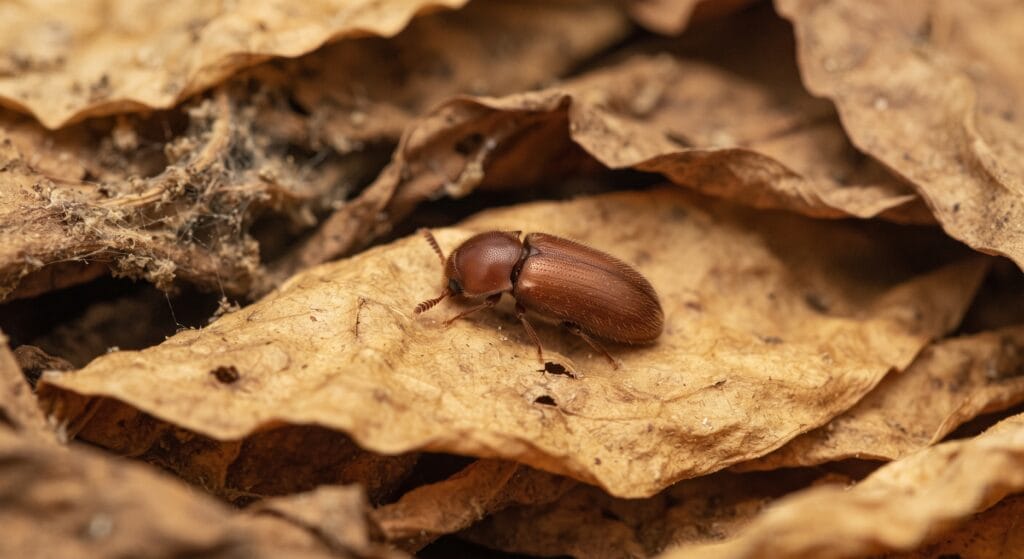
Commonly known in Spanish-speaking regions as the escarabajo del tabaco and internationally as the cigarette beetle or tobacco beetle, Lasioderma serricorne (Fabricius, 1792) is a coleopteran insect belonging to the family Anobiidae.
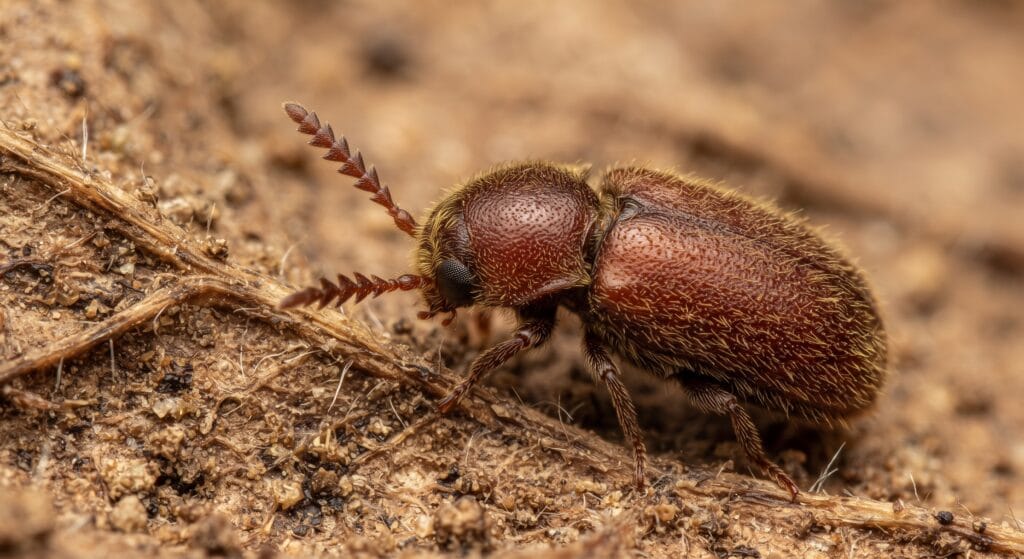
Unlike common weevils (Sitophilus spp.) or other pantry pests such as Stegobium paniceum (drugstore beetle), with which it is frequently confused morphologically, Lasioderma serricorne is physiologically adapted to metabolize complex alkaloids and bitter substances found in Nicotiana tabacum leaves.
Key Differentiation from Stegobium paniceum
- Antennae: Lasioderma serricorne features strongly serrated antennae (saw-toothed). Stegobium paniceum has clubbed antennae (with the final three segments enlarged).
- Elytra: The elytra of Lasioderma are smooth and lack the distinct punctuated striae that characterize the drugstore beetle.
2. Agronomic and Industrial Context
The origin of vulnerability to this pest dates back to the field and post-harvest processing. During natural air-curing or curing in traditional barns (ranchos) and subsequent bulk storage for fermentation, organic matter remains exposed to tropical environments.
- The ecological niche: Tropical production regions with warm, humid climates present optimal environmental conditions for species reproduction if temperature controls inside aging rooms are not rigorously managed.
- Impact on the final product: An affected bale of tobacco or box of rolled cigars loses both physical weight and absolute commercial value. The clean circular holes bored by the insect destroy the draw and aesthetics of the wrapper, rendering the cigar unusable.
3. Biological Development and Lifecycle
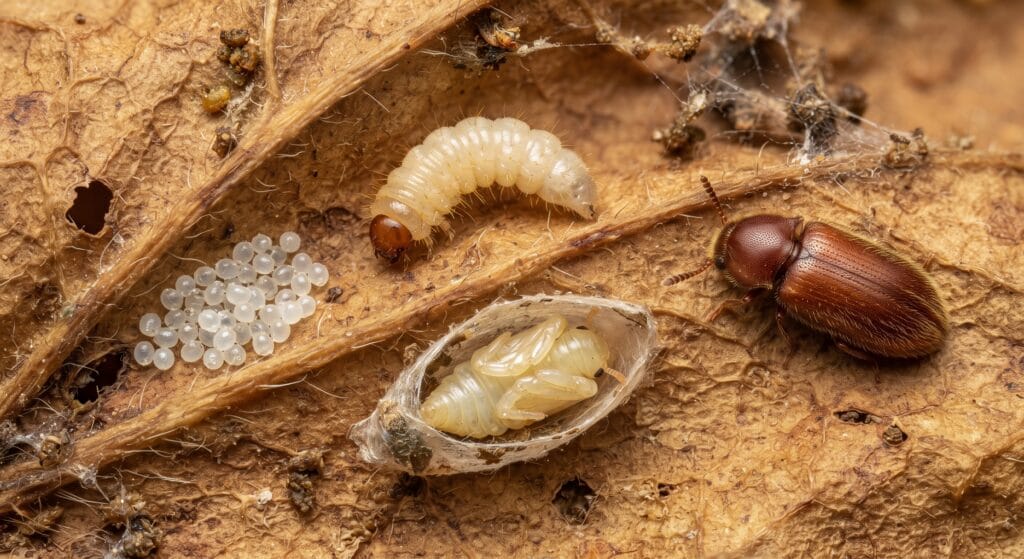
To effectively combat Lasioderma serricorne, understanding its four distinct developmental stages is essential. The speed of this lifecycle depends directly on ambient temperature:
[Egg] ---> [Larva] ---> [Pupa] ---> [Adult (Beetle)]
- Egg Stage: The female lays between 30 and 100 microscopic eggs directly onto tobacco leaves or within the cracks of cigars. Eggs hatch within 6 to 10 days, depending on ambient temperature.
- Larval Stage (The True Damage): This is the most destructive phase. Newly hatched larvae are creamy white with small hooks, and they tunnel deep inside the cigar to voraciously feed on the filler and binder. This larval phase can last from 4 to 10 weeks depending on hygrometric conditions.
- Pupal Stage: The larva constructs a small oval cocoon using tobacco remnants and excrement. Metamorphosis lasts between 1 and 3 weeks.
- Adult Stage: The adult beetle emerges measuring between 2 and 3 millimeters, uniform reddish-brown in color. Its sole biological mission in this final stage is reproduction and dispersion via flight (it is an agile flyer, especially at dusk and in warm environments). Adult beetles do not feed destructively, or consume only a minimal fraction; however, they bore through the wrapper to exit, leaving behind the characteristic exit hole.
The Critical Thermal Threshold
- Below 18°C: The insect’s metabolism slows down significantly; eggs and larvae enter a state of latency or lethargy.
- Between 20°C and 25°C: Moderate biological reactivation begins.
- Above 28°C–30°C with High Humidity: The biological cycle completes in a mere 4 weeks, triggering massive outbreaks or uncontrolled plagues in caves and cellars.
4. Symptoms of Infestation and Physical/Ocular Damage
Early identification of an Lasioderma infestation prevents the total loss of a private humidor or aging cellar. Inequivocal signs of the presence of Lasioderma serricorne include:
- Millimetric Exit Holes: Small, perfectly round holes (approximately 1 mm in diameter) bored into the body or head of the cigar.
- Fine Dust (Frass): Fine powder accumulated at the bottom of the humidor, box, or cellophane sleeve, composed of larval excrement and pulverized tobacco debris.
- Presence of Flying or Crawling Insects: Small reddish-brown beetles moving across cedar wood shelves or interior cave walls.
- Loss of Structure: During a gentle tactile inspection, the cigar feels hollow or soft in specific zones where internal galleries have destroyed the filler structure.
5. Common Errors in Cigarette Beetle Control
When facing an Lasioderma crisis, aficionados and retailers frequently commit severe errors that compromise tobacco health or quality:
- Use of Chemical or Household Insecticides: Spraying commercial aerosols, repellents, or synthetic pyrethroid insecticides inside humidors or onto cigars. Tobacco is highly hygroscopic and absorbs chemical toxins, altering its organoleptic profile irreversibly and rendering it toxic for human consumption.
- Ignoring Thermal Fluctuation: Focusing solely on maintaining relative humidity (70%) while neglecting temperature (allowing it to remain above 24°C or 25°C). The combination of heat and humidity is the ultimate trigger for latent eggs.
- Delayed Disinfection: Waiting to see a flying adult beetle before taking action. By the time the adult emerges, the larva has already completed its destructive cycle inside the tobacco weeks prior.
6. Practical Treatment, Prevention, and Conclusion Protocol
A. Environmental Prevention (The Cellar and Humidor)
- Strictly maintain climate control parameters: temperatures below 18°C–20°C and a constant relative humidity between 65% and 70%.
- Rigorously inspect every box or new cigar added to a private collection before mixing it with existing inventory (a preventive quarantine of 14 to 30 days in a secondary airtight container).
B. Thermal Eradication Treatment (Controlled Freezing)
If an infested batch of cigars is suspected, the only safe, industry-approved, and chemical-free method is controlled cold thermal shock:
- Acclimation Phase (Pre-chill): Place the cigars (inside their original cellophane or an airtight Ziploc bag to prevent sudden condensation) in the least cold compartment of a refrigerator (approximately 4°C) for 24 hours.
- Freezing Phase: Transfer the cigars to a freezer at -18°C for an exact period of 72 hours. This temperature is lethally destructive to all biological stages (eggs, larvae, and pupae).
- Thawing Phase (Post-chill): Return the cigars to refrigerator temperature (4°C) for another 24 hours.
- Stabilization Phase: Remove the cigars from the refrigerator and let them rest at room temperature inside their sealed bag for 24 additional hours so they recover ambient temperature gradually, avoiding thermal shock that would crack wrappers via water expansion.
C. Editorial Conclusion
Managing Lasioderma serricorne is not a matter of luck, but of technical rigor and environmental discipline. Monitoring cellars, keeping thermal ranges below the hatching threshold, and applying preventive freezing protocols upon any sign of suspicion ensures the pristine preservation of tobacco heritage across years to come.